Heartside Historic Mural Madam Bell
This mural tells the story of Grand Rapid’s very own prophetess and clairvoyant Madam Bell.
Martha Ann Boles was born in 1827 in Cincinnati, Ohio and relocated to Grand Rapids after meeting Jeremiah/Jerry Bell. In 1860, Jerry passed from TB; Martha was left to care for 8 children on her own. To care for her family, she turned to her skills in plant medicine and clairvoyance. Many Black, immigrant, and working-class communities would hire her for ailments, spiritual workings, lifting curses, and herbal medicine. Offering affordable price points of 10, 15, and 25 cents; Madam Bell serves clients of all walks of life.
photo credit: Shafi Subhan


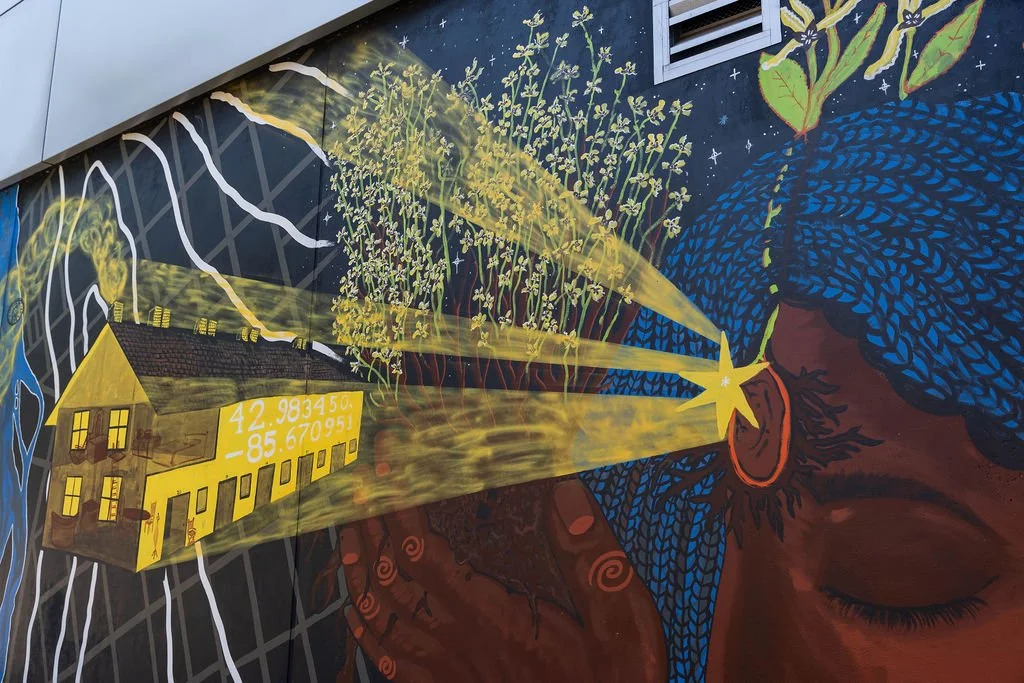


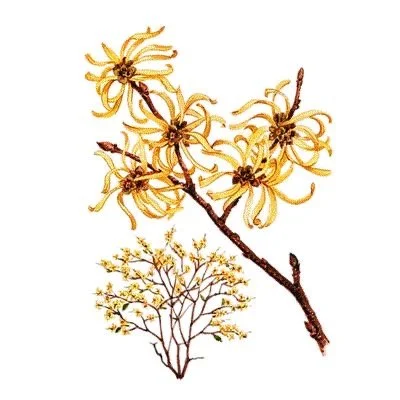
Reading from right to left, the mural begins with the journey of freedom from enslavement. We see Black figures climbing through waves of black and blue braids towards a home with a quilted northern star. The braids represent the wisdom of African ancestors, mothers who have sown seeds into their loved ones' hair for survival. The hair is attached to a 3 headed bust of a cocoa toned woman with her eyes closed. Above is the name ‘Madam Bell’ written in the stars. These three portraits represent past, present, and future forms of Martha Ann Boles, embracing the idea that Boles' knowledge of plants came from her ancestors. In place of the third eye grows a seed of wisdom. Further left, the seed merges with light to become a plant. With open palms to the sky a bush of witch hazel grows from the earth in Martha’s hands. The witch hazel references an article from The GR Herald on March 21, 1875, about a couple who came to Bell to lift a curse, “she told them to get some roots of witch-hazel, make decoction of them, and bather the patient’s body from head to foot.”
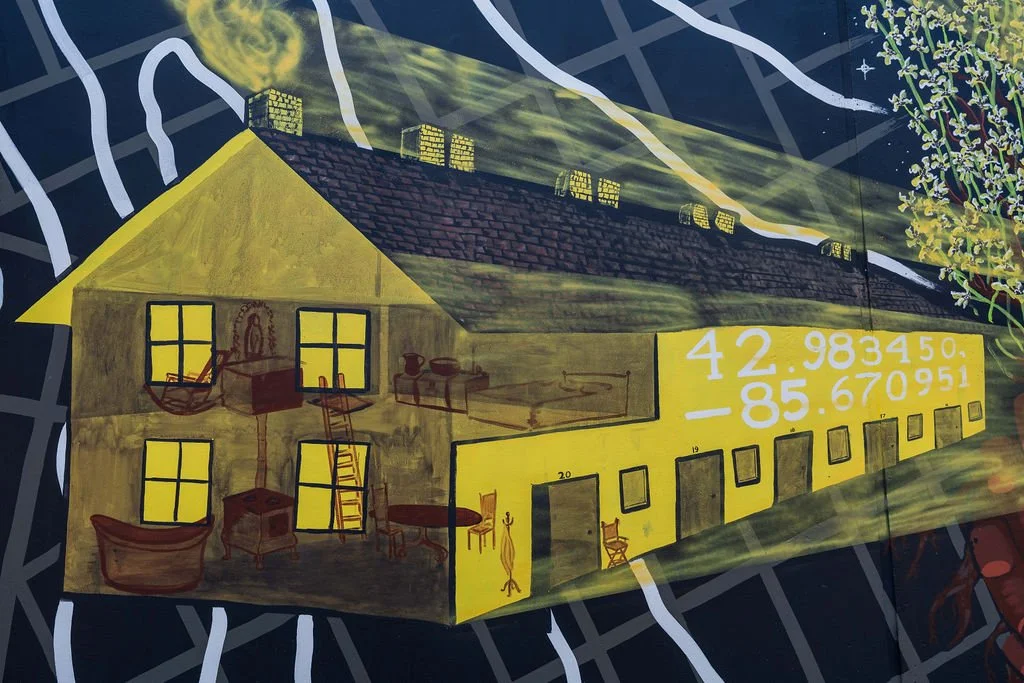
The light erupting from the seed represents a vision, which Bell shared she had many. The light points towards a housing complex called ‘Comstock’s Row,’ located on 20 Canal St. Bell lived in unit #20 approximately from 1874-87. In 1925 the housing was demolished. The city of Grand Rapids held prejudice and racist opinions about the Black citizens that lived 20 Canal. Charles Comstock, who served as mayor of Grand Rapids in 1863, converted a barn into twenty compartment-like “houses”. After the build, 20 Canal received little resources and Charles never corrected the public when the newspapers gave “Comstock ‘s Row” derogatory and racist names. In 1890 a correspondent of the Grand Rapids Evening Leader visited to peel back the curtain. Edith shared,
“The small parlor, about 8 x 10 ft., had a low ceiling; an open door showed a small kitchen containing a stove, table, two chairs, and a wash-bench. Two bedchambers occupied the second floor... Comstock row is, to all appearances, a quiet, orderly and decently behaved place and certainly has a far more moral class of inhabitants than many of our big downtown blocks.”
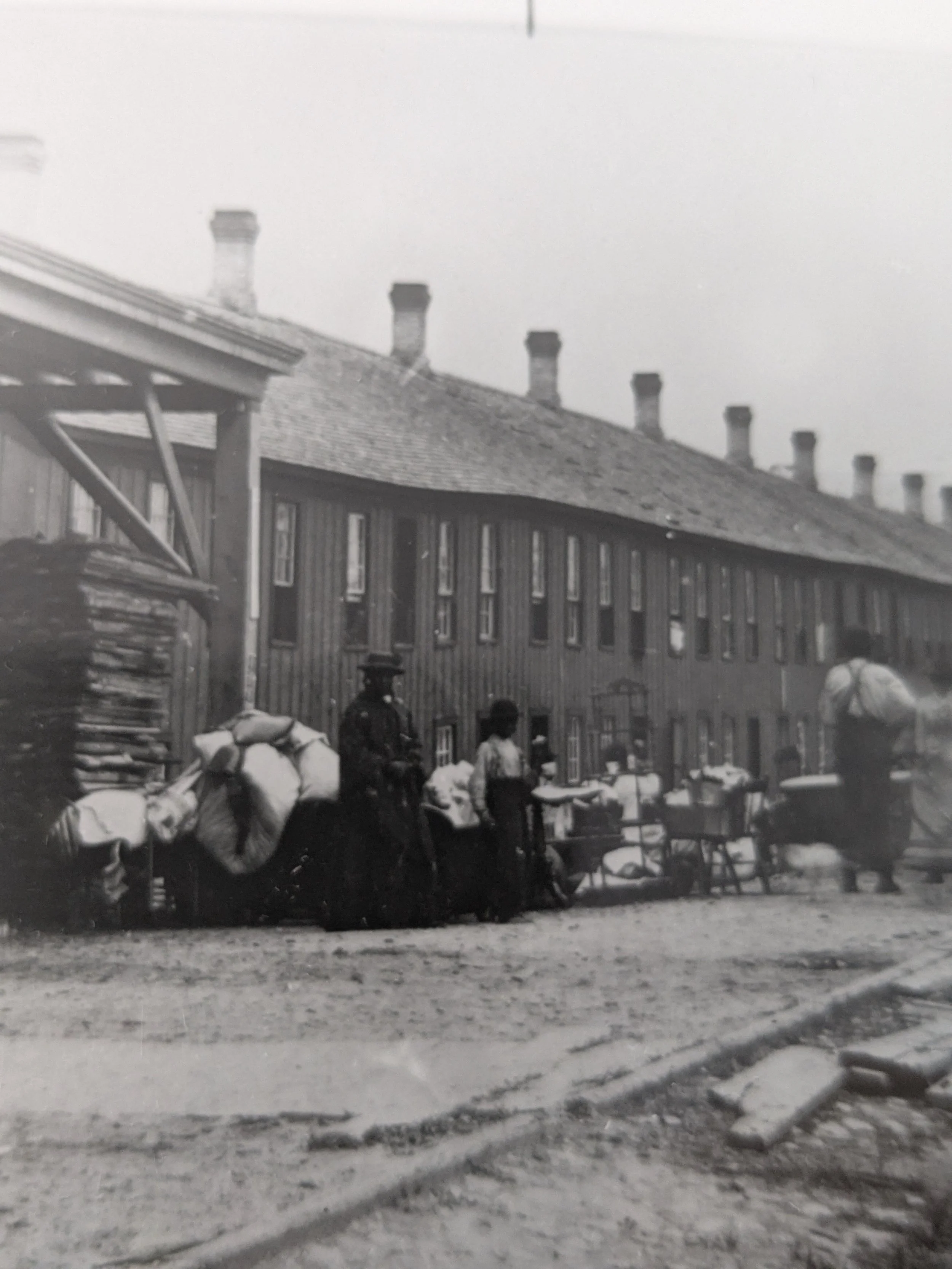
Residents of 20 Canal St outside of their homes with their furniture and furnishings, there was likely flooding so neighbors moved their belongings further up shore to prevent damages. Image was identified by Dr. Randal M. Jelks
The rendering of 20 Canal St is based on such article and includes imaginings of the family’s furniture, bedrooms, kitchen, and coordinates of the home. Surrounding 20 Canal St is a map of Grand Rapids in 1850. Bell lived all over the city – 239 Lagrave, 125 Canal, 208 West Fulton, 290 S Division, and 382 N Ionia. in dark gray are the dividing streets of the city, in white is the topographic lines, and in blue is “Owashtannong” (the Anishinabek name) or the Grand River and its five islands before they were destroyed.


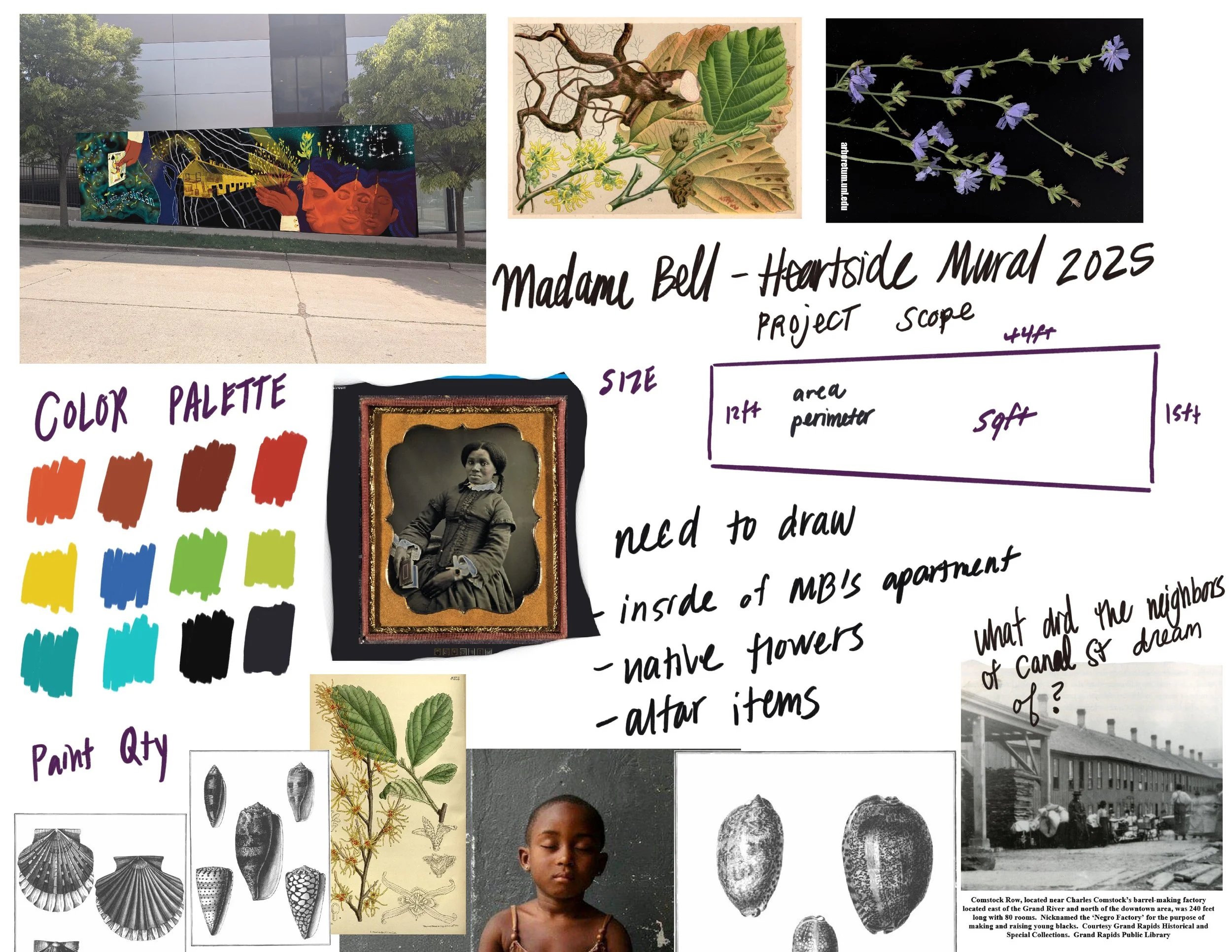
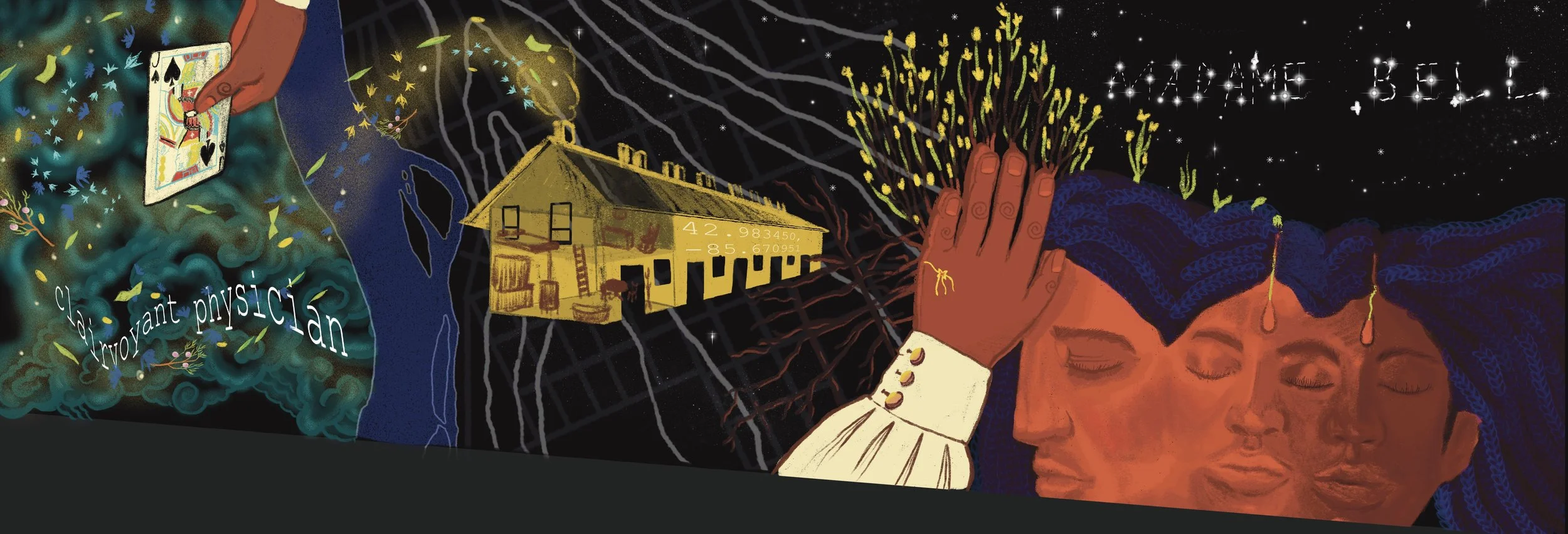

Her vision continues into a cloudy blue and teal mist, which represents the uncertainty of the future. At the top is Bell’s hand reading tarot, she reveals a Jack of Spades, which in cartography represents a man who is enthusiastically pursuing wealth; referencing Charles Belknap description of Bell in “The Yesterdays of Grand Rapids” The Jack of Spade has been reinterpreted into a West African healer/king. Swirling in this ethos is a collection of conjure and healing items. Coins represent good fortune and wealth. Twisted roots represent the complexity of nature, in Hoodoo and Conjure, deformity is beauty because different details are revealed during each observation. A rabbit’s foot and wishbone serve as a long life but also mortality. A satchel with a leather cord is worn around the neck for good luck. Swirling in the smoke are native plants that would have likely been forged by Madam Bell; she would create poultices, tinctures, or balms for healing. Plants like cedar, chicory, dandelion, yarrow, mallow, mustard, clover, mullein, sorrel, and common plantain. The swirls of smoke and clouds continue along the sidewalk, reaching into Dwelling Place’s Commerce Courtyard and garden.


Martha lived in many neighborhoods of Grand Rapids, and her descendants are thriving all over Michigan and Kentucky. Martha's life is a representation of blossoming where you are planted and the tools African Americans used to thrive during a time when medical care was limited, and de facto segregation was present. Martha's impact on Grand Rapids was important as she is one of the few recorded African American herbalists in the city at the time.